

Chapter 1 : What is Strain?
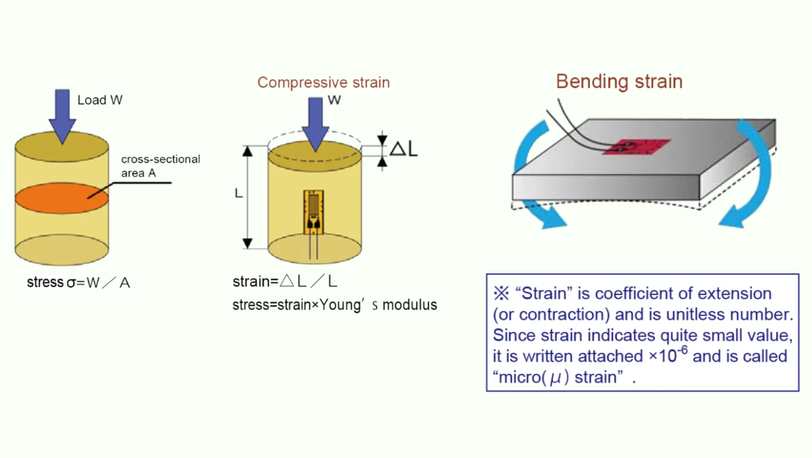
A strain is a quantity of the deformation - elongation or contraction of a material in proportion to applied external force.
Strain gage detects this strain as an electrical signal.
There are various structures made of different materials in varied sizes and shape.
They include transports such as automobiles, aircrafts, railway vehicles and ships, and civil engineering and building constructions such as dams, bridges, and skyscrapers. Measurement of “stress,” which is a criterion of the strength of these structures operating under severe conditions, is indispensable for assurance of the strength and safety.
It is indispensable to know the stress to investigate an optimum design for satisfying the embodiment of a unique idea, lighter structure or selection of a suitable material and the assurance of the strength and safety.
Recently, computer-aided stress analysis techniques have been developed and introduced in the design field. However, experimental stress measurements with strain gages are widely used as the surest and practical method even now.
Strain = Quantity of the deformation – elongation or contraction of a material.

Chapter 2: Principles of Strain Gages
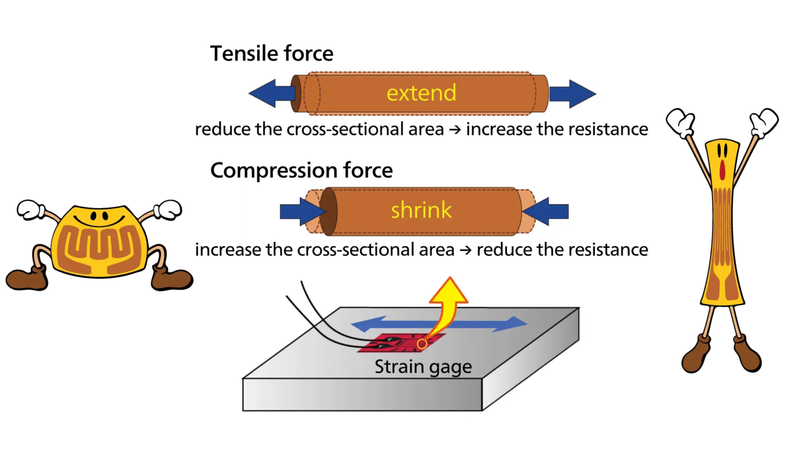
Metal changes its electrical resistance as it deforms. Strain gages take advantage of this property.
The amount of electrical resistance is in inverse proportion to the cross-sectional area and is proportional to the length.
If a metal wire is pulled, the cross-sectional area becomes smaller, and the length becomes longer, thereby making the resistance larger.
If the metal wire is compressed, the electrical resistance becomes smaller.
Elongation or shrinkage proportionally changes the electrical resistance of metal with the specific constant.
If the metal wire is bonded to the target structure, it elongates or shrinks as the structure elongates or shrinks.
Thus, measurement of the changing electrical resistance of the metal wire enables detection of elongation or shrinkage, i.e., “strain” of the structure.
Chapter 3: Selecting Strain Gages
Our strain gages are easy to understand what kind of purpose or environment would be appropriate by model names.Select strain gage models and gage length that match the target object and purposes.

Chapter 4: Bonding Strain Gage
To obtain useful data, correctly bond strain gages to a measuring object.Thus, it is essential to select a suitable adhesive for the materials of the measuring object and measuring conditions.
In case of a general stress measurement by using KFGS gages, the CC-33A instantaneous adhesive is commonly used.
The CC-33A ensures smooth bonding works because of quick curing time.
It also enables measurement in approx. 1 hour after bonding.

Chapter 5: Selecting Measuring Instruments
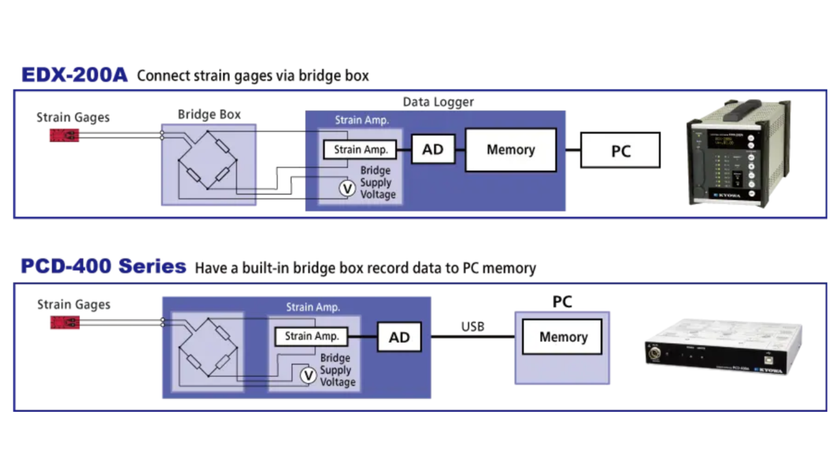
Depending on purposes, note that it is necessary to select an appropriate strain amplifier or data logger.
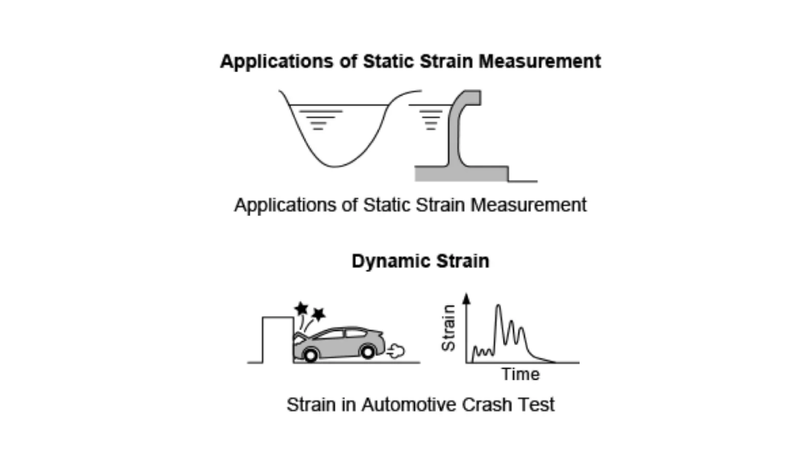
Dynamic strain: Strain which changes rapidly.
Note that the border between static strain and dynamic strain are not defined clearly.
Chapter 6: Measuring Strain
Suppose an original resistance of a strain gage is R (Ω) and a changed resistance due to elongation or shrinkage is △R (Ω).
Calculate the strain ε by the following formula.
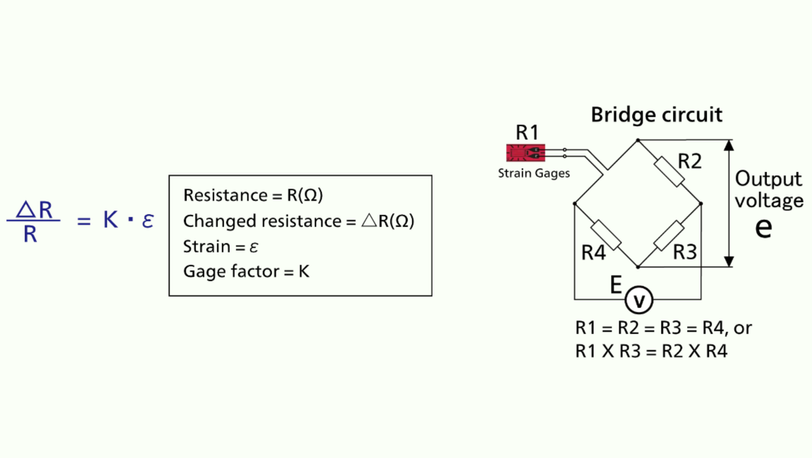
The gage factor of general-purpose foil strain gage KFGS is approx. 2.
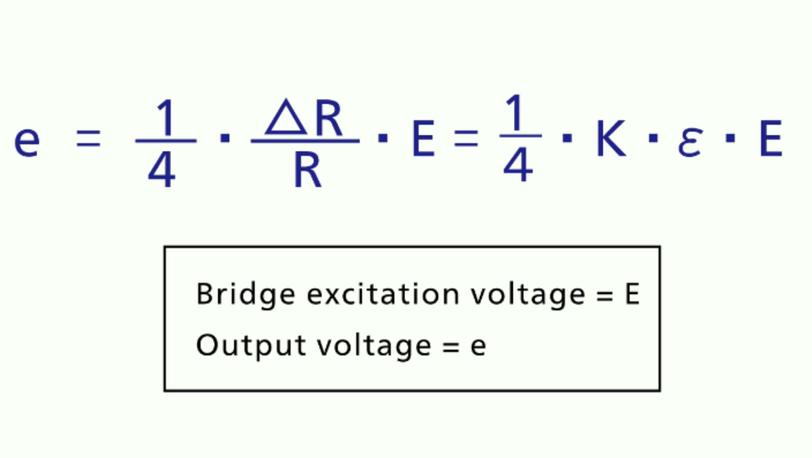
Suppose the bridge excitation voltage is E, strain gage resistance is R (Ω), and a changed resistance due to elongation or shrinkage is △R (Ω).
Calculate the output voltage e (V) by the following formula.
It is challenging to know the stress of an object or a material directly.
Thus, we calculate stress by measuring the stress-based "strain."
Based on the Hooke’s law, that stress is proportionate to strain in the elastic region, stress is determined by measuring strain with strain gages.
Therefore, we often use strain measurement and stress measurement synonymously.
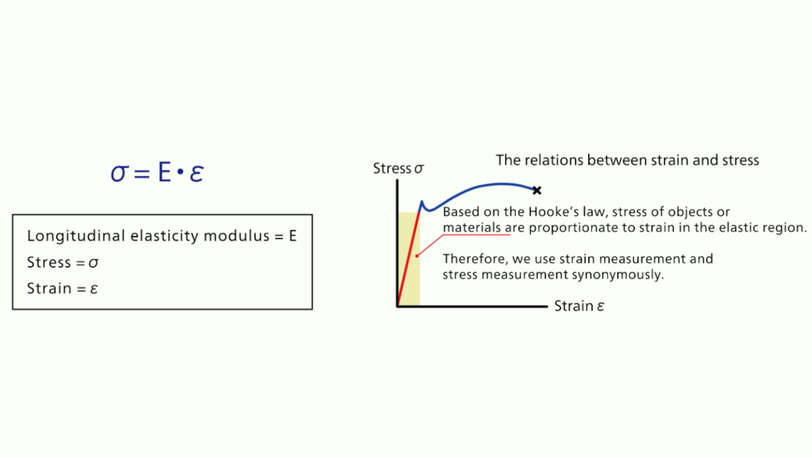
For this reason, when an amount of the applied force and cross-sectional area will be known, stress can be calculated. However, when the measuring object consists of complicated structures, complicated applied loads or complex conditions, it may be challenging to calculate data with high accuracy.
Therefore, experimental stress measurements with strain gages are widely used as the surest and practical method as verification of the safety structure design.
* "Strain" is a coefficient of elongation (or shrinkage) and is a unitless number.
Since strain indicates quite small value, it is written with "×10-6 strain" and is called "microstrain."